 SHOCKSOUNDsteepens a sine into brass
SHOCK
SHOCK bends a sine into a shock wave, the way a loud note steepens as it travels down a brass instrument's bore. Blow harder (a louder envelope) or play higher and it brightens from a pure tone to a buzzing, brassy saw.
steepens a sine into brass
- Half
- SOUND
- Reach it
- white key E4 in the wheel
- ALGORITHM
- DRIVE
- Engine
- SHOCK
- Factory sounds
- 8
Playing it
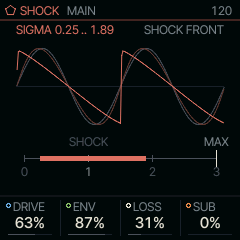
DRIVE on MAIN sets how far the wave steepens at the top of the envelope: at 0 it stays a sine, around the middle the shock forms, and past it the wave turns into a sawtooth that decays like brass. ENV sets how much of that the envelope supplies. At 0 the timbre stays fixed through the note, like a CZ preset; turn it up and each note starts dark and opens as it swells. LOSS is the bore's damping, a low-pass that follows the note (open at 0). SUB adds a sine an octave down.
Try a slow attack on the ENV page with ENV high for swelling horns, or ENV at 0 and DRIVE high for a steady, edgy lead.
SHOCK is on a white key of the wheel (The wheel).
MAIN
| Knob | Label | Range | Starts at |
|---|---|---|---|
| 1 | DRIVE | 0% .. 100% | 63% |
| 2 | ENV | 0% .. 100% | 87% |
| 3 | LOSS | 0% .. 100% | 31% |
| 4 | SUB | 0% .. 100% | 0% |
Pages
SHOCK
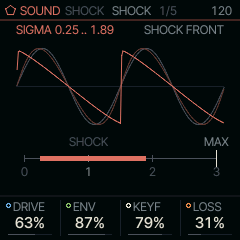
KEYF is the key follow. At 0 every note gets the same timbre; turned up, the steepening grows with pitch, as it does on a real horn. That is the opposite of a CZ synth, whose key follow darkens the high notes.
| Knob | Label | Range | Starts at |
|---|---|---|---|
| 1 | DRIVE | 0% .. 100% | 63% |
| 2 | ENV | 0% .. 100% | 87% |
| 3 | KEYF | 0% .. 100% | 79% |
| 4 | LOSS | 0% .. 100% | 31% |
AIR
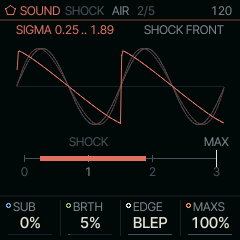
BRTH blows breath noise through the same bore. EDGE RAW leaves the shock's step unfiltered, which aliases (folds high harmonics back down as harsh tones); BLEP smooths it. MAXS is the ceiling on how far DRIVE can push the wave.
| Knob | Label | Range | Starts at |
|---|---|---|---|
| 1 | SUB | 0% .. 100% | 0% |
| 2 | BRTH | 0% .. 100% | 5% |
| 3 | EDGE | RAW BLEP | BLEP |
| 4 | MAXS | 0% .. 100% | 100% |
Factory sounds
- BRASS
- CZ SAW
- BLOOM
- SHOCK BASS
- HORN SECTION
- TUBA
- BREATH
- RAW SHOCK
Where it comes from
The wave is Earnshaw's simple wave, which has the same form as Kepler's equation: the sample read at phase θ is sin(φ) with θ = φ − σ sin(φ), where σ is the distance travelled in shock-formation lengths. SHOCK reads it from a precomputed table instead of solving it per sample. firmware/src/eng_shock.c, shock.c and shock.h, from databurn (MIT).