01Rooms are mirrors
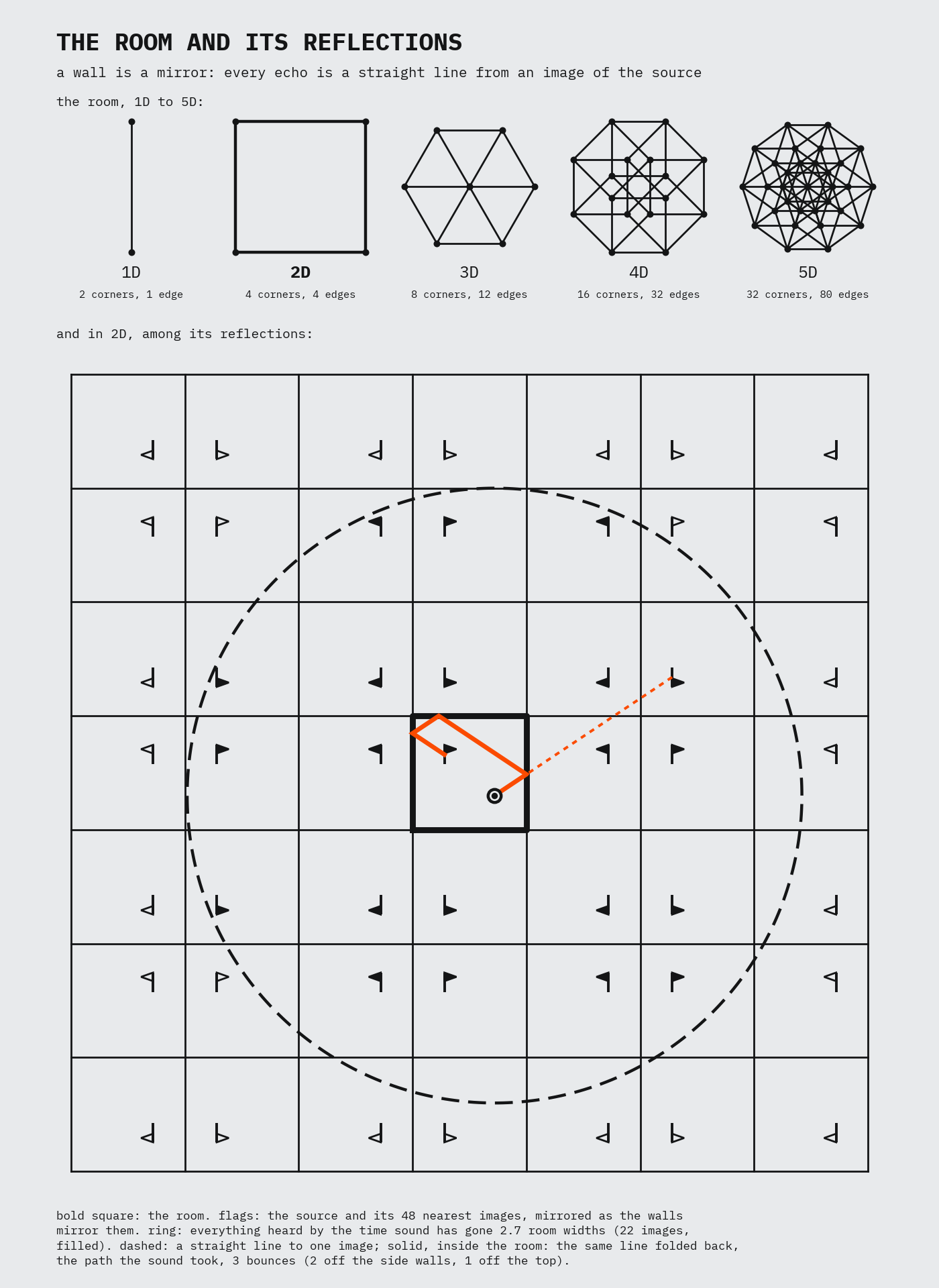
A wall reflects the source, so every echo is a straight line from a copy of it.
Mirror a source in a wall and you get an image of it behind the wall; mirror the image in the opposite wall and you get another. A box room becomes a lattice of copies, one per room volume, and each echo is the straight line from one copy to your ear (Allen and Berkley 1979). Nothing in that construction cares how many dimensions the box has. A box in 1D is a line with two ends, in 2D a rectangle, in 4D a tesseract with 16 corners and 32 edges.
What changes with the dimension is how fast the copies arrive. The images within reach grow as tN, so echoes arrive at a rate that grows as tN-1: steady along a line, growing linearly in a plane, as the square in a room, as the cube in a tesseract.
02The reverb of Flatland
A. Square's house, as a 2D room, never goes quite silent.
In Flatland you know people by their voices before anything else:
The first means of recognition is the sense of hearing; which with us is far more highly developed than with youAbbott, Flatland (1884), Part I, Section 5
Abbott never says how sound behaves in the plane; the acoustics here are ours. In two dimensions a sound does not stop when its front has passed. A tail follows every front, fading but never quite ending, because only in odd dimensions from three up does a click stay a click (Huygens' principle, in its strong form). In the house the tail shows as the pressure staying below ambient from the moment the voice arrives until the first echo.
The house is Abbott's pentagon (Part I, Section 2): roof to the north, the Men's door west, the Women's east, no door in the floor. We simulated it with 2D finite differences, 7 mm cells and rigid walls; the size (5.71 m wide) and the door widths are ours, because Abbott gives neither.
- a vowel, dry
- the vowel in the house
- a clap in the house
03From the next room
His own house, after Abbott's plan, heard room by room.
In Part II the Sphere lifts the Square out of the plane, and for the first time he sees his own house from above:
My four Sons calmly asleep in the North-Western rooms, my two orphan Grandsons to the SouthAbbott, Flatland (1884), Part II, Section 18
We drew the house after Abbott's Illustration 9 and let the Square speak in his study. Every other room hears him later and quieter, by the shortest way through the doors: the bedroom after 5.8 ms, the Hall 7.2, the cellar 12.0, a passer-by outside 15.7. Where no doorway lines up, the sound comes round the edge of a door.
The Sphere, one dimension up, needs no doors at all. When he speaks to the Square, his voice reaches him with no path through the house:
from the depths of nowhere came forth a hollow voice--close to my heart it seemedAbbott, Flatland (1884), Part II, Section 16
- in the study
- in the bedroom
- in the Hall
- in the cellar
- outside
04Lineland is a pipe
The King of Lineland is measured by the gap between his two voices.
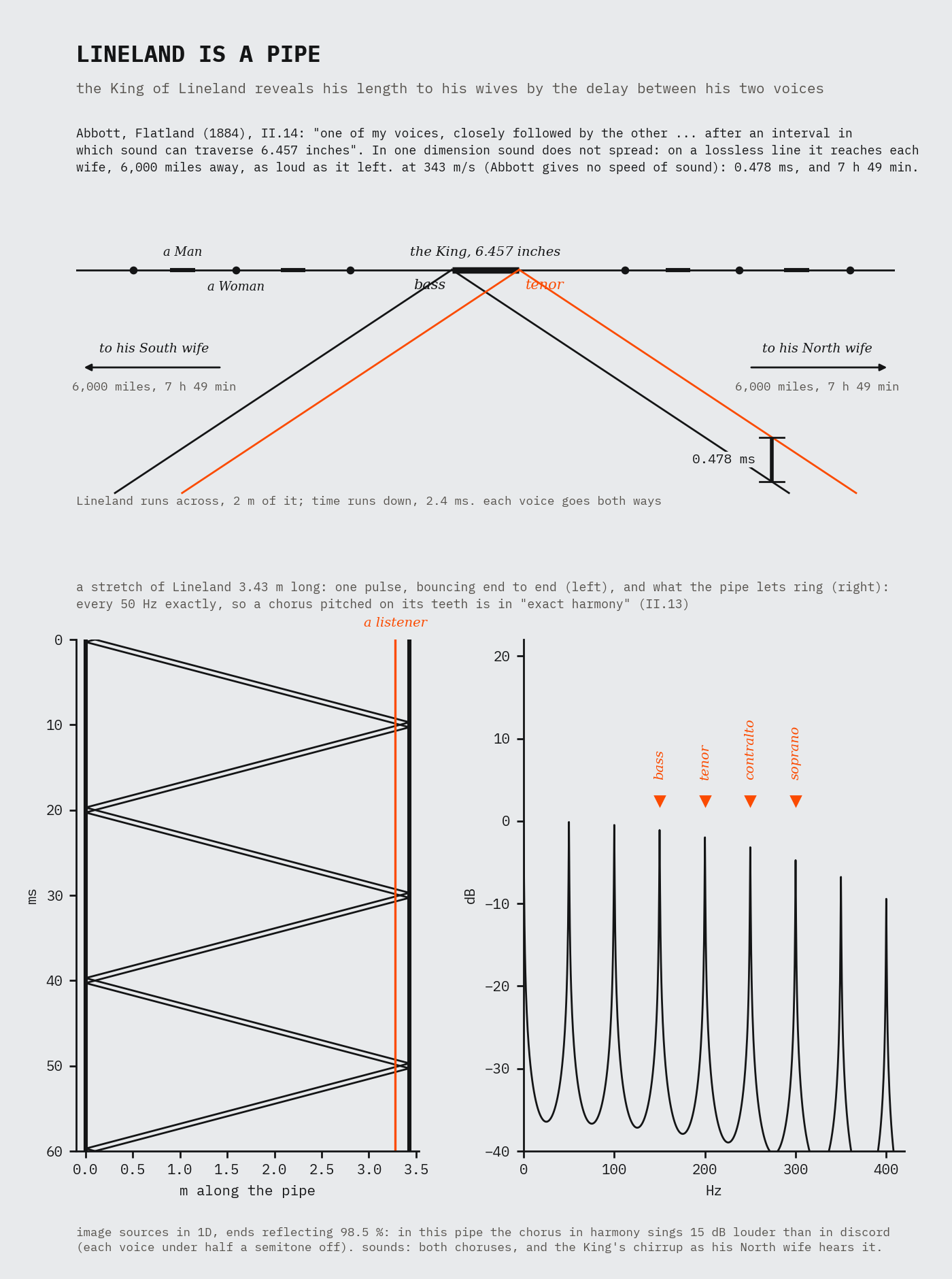
Every man in Lineland has two voices, a bass at one end and a tenor at the other, and that is how his wives know his size:
receiving the sound of one of my voices, closely followed by the other, and perceiving that the latter reaches them after an interval in which sound can traverse 6.457 inchesAbbott, Flatland (1884), Part II, Section 14
In one dimension sound does not spread. On a lossless line the King's voice reaches his wives, 6,000 miles away, as loud as it left, the two voices 0.478 ms apart, after 7 h 49 min (at 343 m/s; Abbott gives no speed of sound).
A stretch of Lineland between two walls is a pipe. It rings at exact multiples of one frequency, 50 Hz for 3.43 m of it, and its echoes never thicken into a reverb: they stay a flutter forever. A chorus pitched on those multiples is in Abbott's "exact harmony" (Part II, Section 13). In the pipe it sings 15 dB louder than the same chorus with each voice under half a semitone off.
- the chorus in exact harmony
- the chorus in discord
- the King's chirrup, as his North wife hears it
05Your plate reverb isn't from Flatland
A plate is flat, but it bends; a drum skin is the real 2D room.
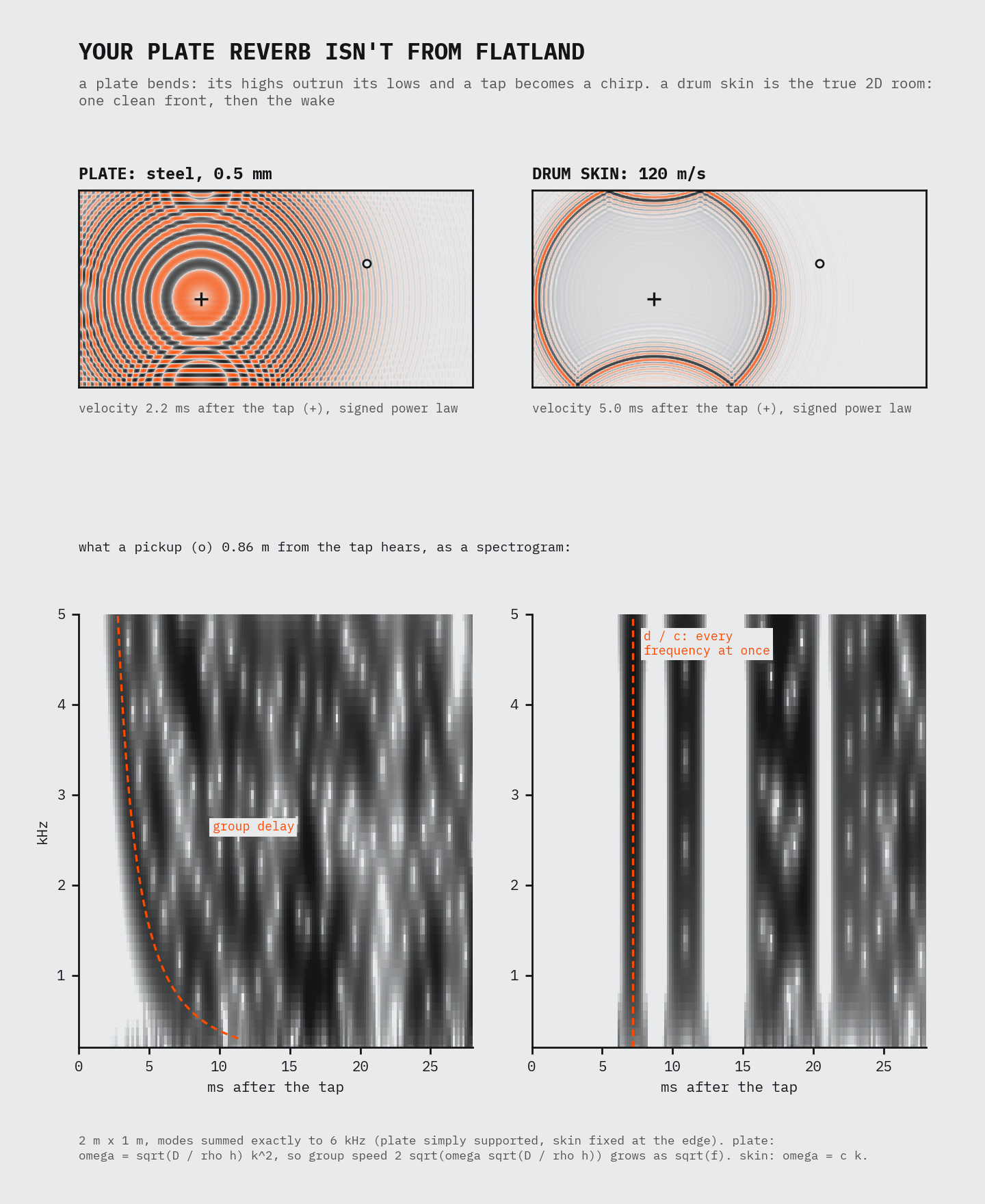
A steel plate carries bending waves, and bending waves are faster the higher they are: speed grows as the square root of frequency. Highs outrun lows, so every tap and every echo arrives as a falling chirp. A plate's mode count also grows like a string's, not like a plane's. That chirp is the sound of a plate reverb, and it comes from the steel, not from two dimensions. Springs are the same story in 1D.
A stretched membrane carries every frequency at one speed: one clean front, then the wake. A drum skin, not a plate, is the honest Flatland room.
- a tap on the plate
- a tap on the drum skin
06Even dimensions leave a wake
In 3D and 5D a click ends; in 2D and 4D it leaves a tail.
Clap in an open field and the sound passes you as a thin shell: before it, silence; after it, silence. That is special to odd dimensions from three up. In 2D the inside of the shell fills with a tail that fades but never stops; in 4D the tail is short and negative. 5D is sharp again, but the click arrives differentiated, sharper than it left.
A real source that starts and stops shortens the tail. The near part stays audible as a tilt in the spectrum, about 3 dB per octave for every dimension away from three: a 2D room is darker, a 4D room brighter. The rest of the tail is below hearing.
Distance costs more in more dimensions, too. Double your distance from a source and it drops 0 dB in a pipe, 3 in a plane, 6 in our space, 9 in 4D and 12 in 5D.
07The room goes diffuse
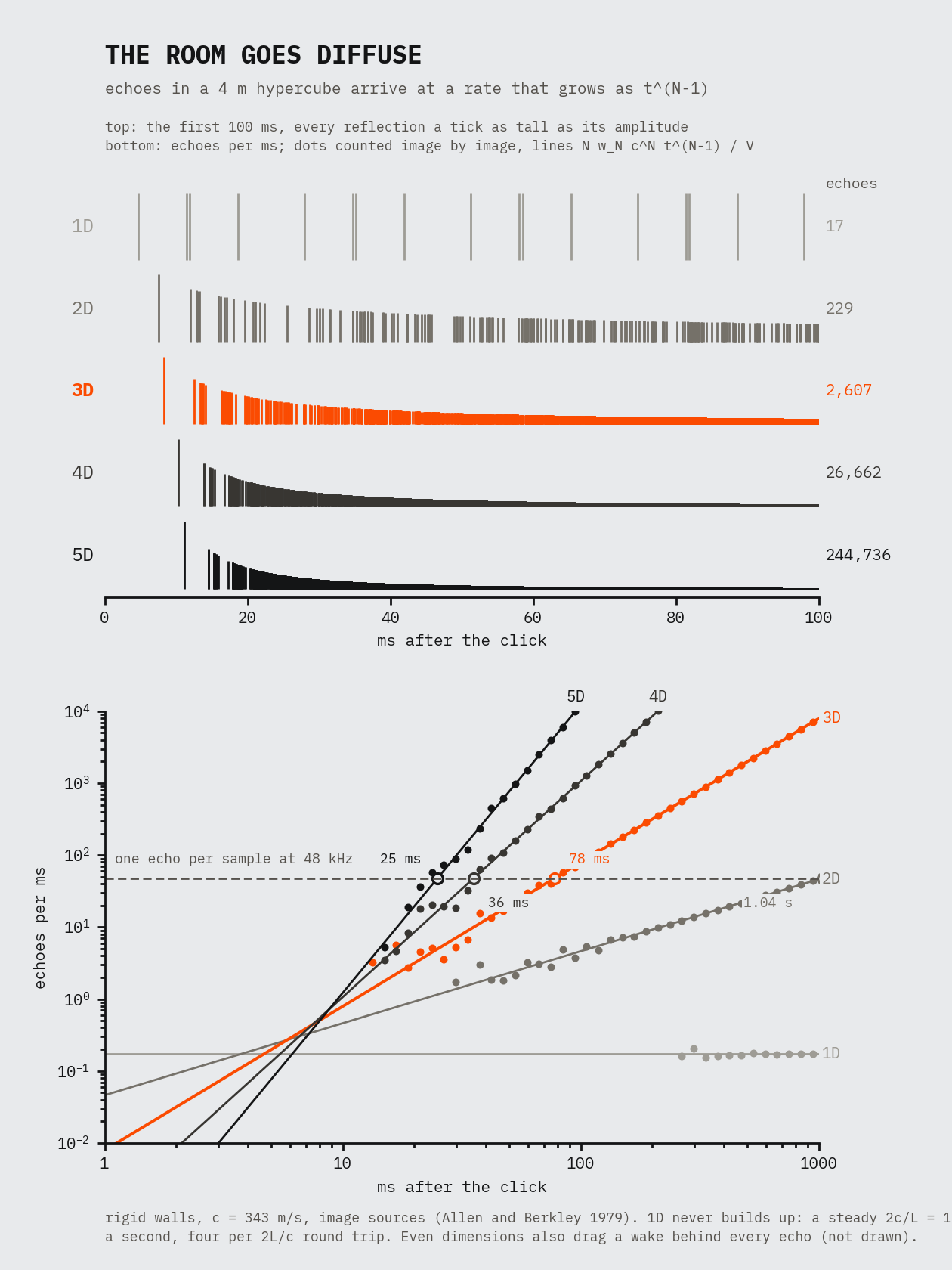
More dimensions, more echoes, sooner.
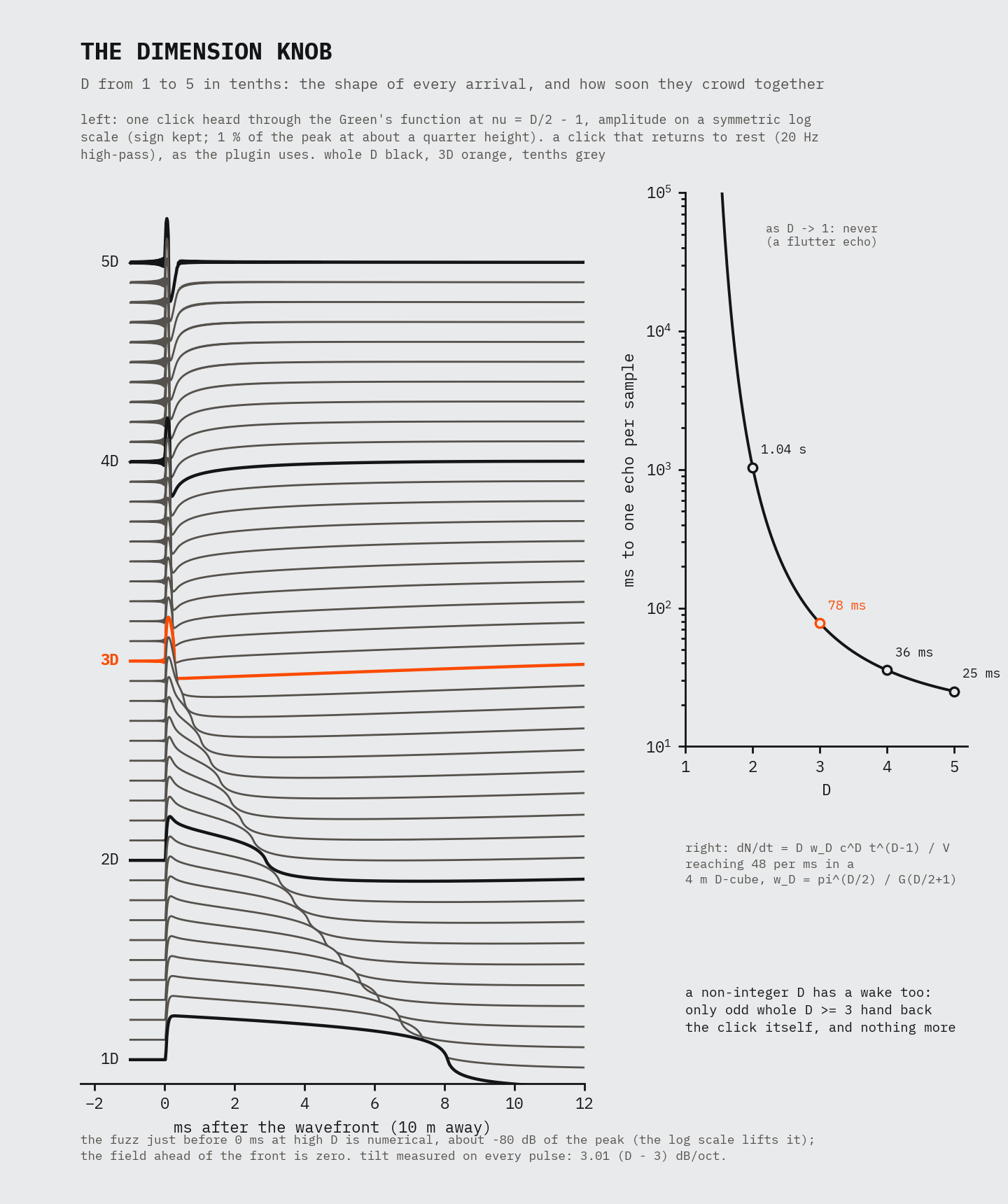
Early on you can pick out single echoes. Later they crowd into a hiss, and the moment they reach one per sample is a fair line for when a room stops sounding like echoes and starts sounding like reverb. In a 4 m hypercube at 48 kHz that takes 1.04 s in 2D, 78 ms in 3D, 36 ms in 4D and 25 ms in 5D. In 1D it never happens; Lineland stays a flutter.
In 2D and 4D every one of those echoes also drags a wake behind it, so the reverb smears before it even gets dense.
08Hearing the dimension
A room's resonances count its dimensions.
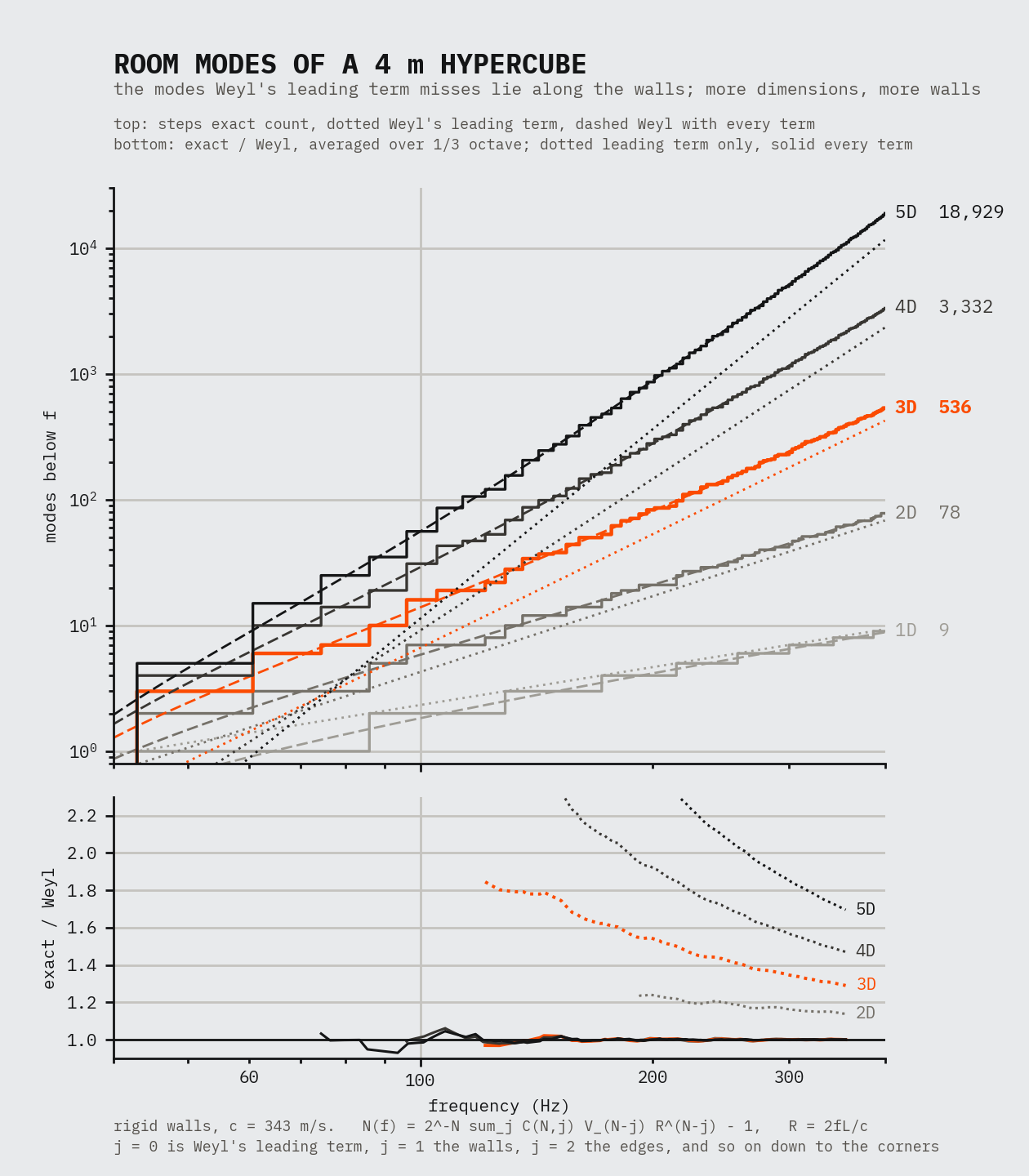
Below any frequency a room has a certain number of resonances, its modes. Weyl showed in 1912 that the count grows as the frequency to the power of the dimension: double the frequency and a pipe has twice as many modes, a plate four times, a room eight, a tesseract sixteen. So a room's dimension is written in its spectrum.
Kac asked in 1966 whether you can hear the shape of a drum. The answer turned out to be no, not quite. But you can hear its area and, through Weyl, its dimension. Fractal drums go further: their count grows as a fractional power, 1.37 for a Sierpinski gasket, a room with a dimension between one and two.
The claps below are made only from each box's modes under 400 Hz, so the dimension is the only thing that changes.
- a clap from the modes of a 1D box
- a clap from the modes of a 2D box
- a clap from the modes of a 3D box
- a clap from the modes of a 4D box
- a clap from the modes of a 5D box
09Half a dimension
The formulas don't need whole numbers, so neither does the knob.
Both things that set a room's sound in this model, the shape of each arrival and how fast arrivals come, are smooth functions of the dimension D. Nothing breaks at D = 2.5. The plugin's DIMENSION knob runs from 1 to 5 in hundredths.
A fractional D has a wake too. Only the odd whole numbers from three up hand back the click itself and nothing more. Physically, a fractional dimension is what fractal resonators have: a network of ducts on a Sierpinski pattern rings like a room of dimension 1.37.
10Inside the tesseract
A 4D room holds every note a 3D room leaves out.
A box's modes sit at the fundamental times √k, where k is a sum of squares of whole numbers, one per dimension. A cube cannot make every k: Legendre showed that numbers of the form 4a(8b+7) are never a sum of three squares, so a cube's series has gaps at 7, 15, 23, 28, 31 and on. Every whole number is a sum of four squares (Lagrange, 1770), so a tesseract with rigid walls has them all. Its modes also stack up more, so a small tesseract rings in chords.
The long diagonal is an octave. The mode that runs corner to corner, (1,1,1,1), lands at exactly twice the fundamental. The cube's diagonal, (1,1,1), is √3: 951 cents, between a major sixth and a minor seventh.
| k | ratio | cents | Hz, 3 m | cube modes | tesseract modes |
|---|---|---|---|---|---|
| 1 | √1 | 0 | 57.2 | 3 | 4 |
| 2 | √2 | 600 | 80.8 | 3 | 6 |
| 3 | √3 | 951 | 99.0 | 1 | 4 |
| 4 | √4 | 1200 | 114.3 | 3 | 5 |
| 5 | √5 | 1393 | 127.8 | 6 | 12 |
| 6 | √6 | 1551 | 140.0 | 3 | 12 |
| 7 | √7 | 1684 | 151.2 | none | 4 |
| 8 | √8 | 1800 | 161.7 | 3 | 6 |
| 9 | √9 | 1902 | 171.5 | 6 | 16 |
| 10 | √10 | 1993 | 180.8 | 6 | 18 |
| 11 | √11 | 2076 | 189.6 | 3 | 12 |
| 12 | √12 | 2151 | 198.0 | 1 | 8 |
| 13 | √13 | 2220 | 206.1 | 6 | 16 |
| 14 | √14 | 2284 | 213.9 | 6 | 24 |
| 15 | √15 | 2344 | 221.4 | none | 12 |
| 16 | √16 | 2400 | 228.7 | 3 | 5 |
Modes per k with rigid walls, in a 3 m box (fundamental 57.2 Hz). Struck rows are the notes a cube cannot play.
Our ears are in a 3D slice of that room. A diffuse field reaches two ears from every direction, and the more dimensions feed it, the less of each arrival lies along the line between the ears. So in more dimensions the reverb stays the same at both ears up to a higher frequency. With ears 18 cm apart and no head, the two ears stop agreeing at 729 Hz in 2D, 953 in 3D, 1162 in 4D and 1363 in 5D. The tesseract's reverb sits a little nearer the middle of your head. In our first renders the difference over the whole spectrum is small; it lives in the band between those numbers.
And the echoes come from outside our space. In the cube every echo arrives inside the room you can see; in the tesseract most of them arrive at an angle out of our slice, from ana or kata, a median of 26 degrees out in the first 40 ms. A quarter of the echo energy comes from more than 30 degrees out of the space we live in.
- a voice in a 3 m cube
- the same voice in a 3 m tesseract
11A voice from ana
Move a source into the fourth direction and it loses its side.
Charles Hinton named the two ways along the fourth axis ana and kata, in print by 1886: the up and down of a direction we can't point to. Put a source in the tesseract to your right, then slide it ana, out of the slice your ears live in. Its path to you gains a stretch along the fourth axis, and that stretch is the same for both ears. It adds delay and distance but no left or right.
In the render, the source starts 1.1 m to the right. In our slice its sound reaches the right ear 440 µs before the left; moved 1.4 m ana, only 301 µs before, and it arrives 5.6 ms after the click instead of 3.8 (fig. 10, panel D). Far enough ana, any source is dead centre. Our space has a version of this, the confusion between ahead, above and behind, but what is left here is distance with no direction at all.
Abbott used the same trick twice. To the King of Lineland, the Square, off the line, is a voice "as it were from my own intestines" (Part II, Section 13). To the Square, the Sphere is a voice "close to my heart it seemed" (Part II, Section 16).
- the voice in our slice, 1.1 m to the right
- the same voice, moved 1.4 m ana
Free ears, no head: what a 3D body does in a 4D room (a paper cut-out, or a slice of something thicker) is still open.
12Stranger rooms
Ideas we have not built yet.
Pointland is feedback
What It thinks, that It utters; and what It utters, that It hearsAbbott, Flatland (1884), Part II, Section 20
A room with no dimensions hears only itself. Turn DIMENSION down to zero and the room should become a loop that rings on its own.
The skin of the tesseract
The tesseract's surface is eight cubes glued into a closed 3D space. A creature living on that surface would find all its curvature on the 32 edges, and would hear a source behind an edge twice, the way light bends round a cosmic string (Deser and Jackiw 1988).
Rooms that refocus, rooms that lose echoes
On a 3-sphere, a sound that goes all the way round comes back together at the far point and again at home, though real sound blurs a little more each trip. In hyperbolic space there is more room than fits, sound fades exponentially past the curvature radius, and some echoes never come back.
Bigger on the inside
The house in Danielewski's House of Leaves (2000) measures larger inside than outside. As a room, that means echoes that come back later than the outside walls allow. A room that grows while its tail is still ringing would make its echoes drift in pitch.
Angles
Lovecraft's "The Dreams in the Witch House" (1933) puts an attic room at angles that lead out of space, and in "From Beyond" (written 1920) a machine makes its users perceive other planes. Hinton's cubes, Abbott's Sphere and Lovecraft's angles are the same wish: to sense a direction you can't point to. Hearing gets closer than seeing.
13The plugin
FourthWall: one reverb, two kinds of room.
FourthWall 0.2 is a small open-source reverb, CLAP and VST3, GPL-3.0. It is built but not released yet.
| control | range | what it does |
|---|---|---|
| DIMENSION | 1 to 5, in hundredths | the shape of every arrival and how fast arrivals come |
| SIZE | 2 to 40 m | the side of the room |
| DECAY | 0.2 to 8 s | time to fall 60 dB |
| MIX | 0 to 100 % | dry to wet |
| TESSERACT | off, on | puts you in a 3D slice of a 4-cube |
| ANA | 0 to 100 % | moves the source along the fourth axis, up to 0.95 of the way to the far wall |
| SOFT W WALLS | off, on | makes the two walls on the fourth axis pressure-release: every echo off them flips sign |
With TESSERACT off the room is statistical. Arrivals come at the D-dimensional rate, each with the D-dimensional shape. What that simplifies: every arrival has the shape it would have at 5 m (real wakes lengthen with distance); there are no early reflections, so the late field is smooth and has no room modes; a fractional D blends the two nearest tabulated shapes; below D = 2 a flutter from a 1D pipe is blended in by energy.
With TESSERACT on the room is a 4-cube of side SIZE, and DIMENSION is not used. For the first 100 ms or more you hear its own echoes at your two ears, one image at a time, from the same model as the tesseract sounds on this page; the statistical 4D field takes over after that. Your input goes in as one source. In its tests the plugin reproduces the arrival time and the difference between the ears of fig. 10, panel D, at every 5 cm of ana. Below about 200 Hz it plays the room's own modes, summed exactly, so SOFT W WALLS moves the bass as well as the first echoes.
Others got to N-dimensional rooms first. McGovern listened to image-source rooms from 1D to 12D in 2011, fractional ones too; NuSpace Audio's free Riviera has shipped a reverb with rooms of any dimension since 2017; Luo's 2026 paper makes counting the images fast up to 12 dimensions. What we add is what the dimension does to every arrival (the wake and the tilt), a listener whose ears live in a 3D slice, ana and kata, and the walls on the fourth axis.
14Sources
Where the claims come from.
- Edwin A. Abbott, Flatland: A Romance of Many Dimensions, 1884. Public domain; Project Gutenberg #97.
- J. B. Allen and D. A. Berkley, "Image method for efficiently simulating small-room acoustics", JASA 65(4), 943-950, 1979; doi:10.1121/1.382599.
- H. Weyl, "Das asymptotische Verteilungsgesetz der Eigenwerte linearer partieller Differentialgleichungen", Math. Ann. 71, 1912.
- M. Kac, "Can one hear the shape of a drum?", Amer. Math. Monthly 73(4), 1966.
- R. Courant and D. Hilbert, Methods of Mathematical Physics vol. 2, 1962 (Huygens' principle).
- H. Kuttruff, Room Acoustics, 6th ed., 2016.
- L. Cremer, M. Heckl and B. Petersson, Structure-Borne Sound, 3rd ed., 2005 (bending waves).
- S. Alexander and R. Orbach, "Density of states on fractals: fractons", J. Physique Lett. 43, 1982.
- A. Kelloniemi, P. Huang, V. Valimaki and L. Savioja, "Hyper-dimensional digital waveguide mesh for reverberation modeling", DAFx-07, 2007. A 4D mesh used as a reverb.
- S. McGovern, "The image-source reverberation model in an N-dimensional space", DAFx-11, 2011; pdf. Image sources in rooms up to 12D and in fractional dimensions, listened to.
- Y. Luo, "Gauss circle lattices with geometric convolutions for synthesizing high dimensional image-source room impulse responses", DAFx26, 2026; arXiv:2606.04358.
- NuSpace Audio, Riviera: Hyper-Room Reverb, a free plugin, 2017: specular reflections in rooms of any number of dimensions.
- S. Deser and R. Jackiw, "Classical and quantum scattering on a cone", Commun. Math. Phys. 118, 1988.
- C. H. Hinton, "A Picture of Our Universe", in Scientific Romances, 1884-1886.