01What this is
The model behind FourthWall, in equations.
Octachoron, the eight-cell, is what geometers call the tesseract: the 4D cube, bounded by eight cubes. No room with four dimensions exists, so nothing here was measured. We asked what a room with D dimensions would sound like if sound in it obeyed the same wave equation as ours, and followed the mathematics. Where it is standard we cite it; where we had to choose, we say the choice is ours. The figures and sounds are on the main page.
Every number below is recomputed when this page is built, from the formulas or from our renders, and the build stops if one disagrees. Our choices throughout: sound travels at m/s, the air is lossless, the room is a box with rigid walls unless we say otherwise, and a listener is two points 18 cm apart, with no head.
Conventions. The frequency-domain formulas use the physicist's time dependence and Hankel functions of the first kind. Where we say what a filter does to audio, we use the signal-processing convention instead (), and say so: the two differ by a complex conjugate, so phases change sign.
02One equation in every dimension
Only the Laplacian grows a term per axis.
Pressure in a room of any dimension obeys
The speed is the same in every direction and every dimension. Everything else on this page follows from that equation, the walls, and where the listener is. Why our world has three dimensions is an old question (Ehrenfest, 1920); this page only asks what the others would sound like.
03A point source
Distance costs more in more dimensions, and the spectrum tilts.
At one frequency, with , a point source in D dimensions radiates
where is a Hankel function. In 3D it is the familiar . Far from the source,
Two consequences. Intensity falls as , so doubling your distance costs 0 dB in 1D, 3.01 in 2D, 6.02 in 3D, 9.03 in 4D and 12.04 in 5D. And the amplitude grows with frequency as : every octave gains 3.01 dB of power per dimension above three. A 2D room is 3.01 dB per octave darker than ours, a 4D room 3.01 brighter, a 5D room 6.02. Only in 3D is the far field flat.
In signal-processing terms, a D-dimensional arrival is the 3D one passed through a fractional differentiator of order :
a tilt and a constant phase. A 4D arrival is a half-differentiated 3D one, its phase +45 degrees at every frequency (the build reads it off equation (2)'s exact Hankel form). A 2D arrival is a half-integrated one, -45 degrees. Apart from the tilt, what a 4D room does to each echo is that constant phase: a fractional Hilbert transform, .
04The wake
In odd dimensions from three up, a click stays a click.
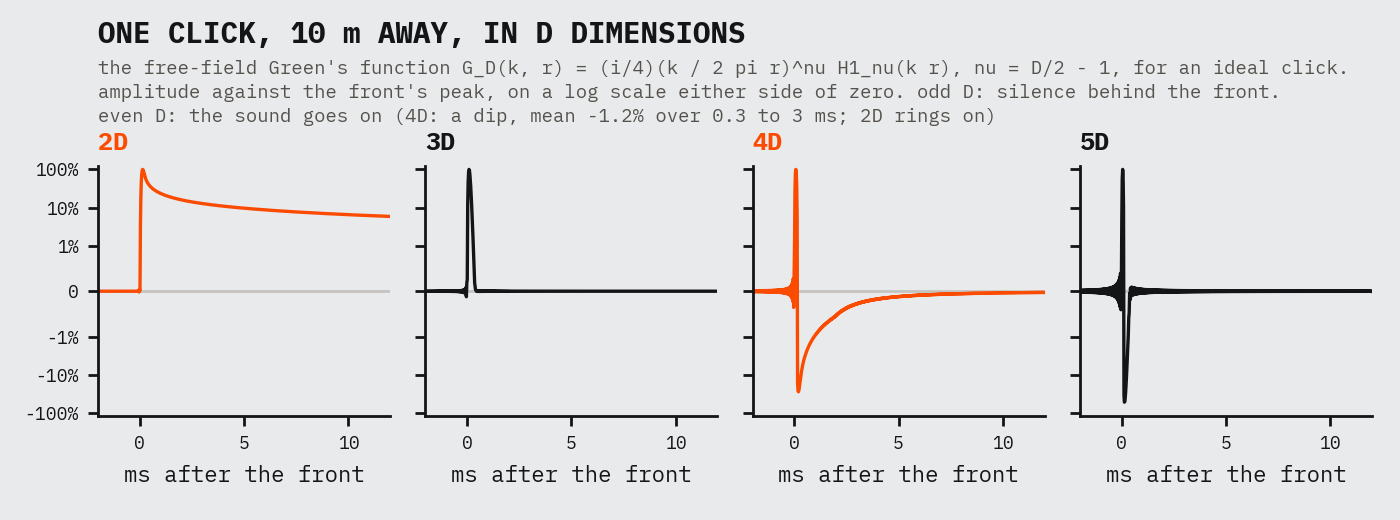
In time, the response to a click in 3D is a thin shell and nothing else:
In 2D the shell is followed by a tail that never quite ends:
with the unit step. This is Huygens' principle in its strong form: it holds in odd dimensions from three up and fails in every even one (Hadamard's problem, 1923; Soodak and Tiersten give the clearest account). The 4D response is a sharper front followed by a negative tail that dies fast; 5D is sharp again, but the click arrives differentiated. Every echo in an even-dimensional room drags its own wake. A real source that starts and stops shortens the tail; what is left is mostly the tilt of section 03. Balakrishnan's title says it best: odd is better, but three is best.
05Image sources
A box room in D dimensions is a lattice of copies of the source.
Reflect the source in each wall of a box of side , then reflect the reflections. Along each axis the copies sit at
and the copies of all D axes combine. The sound from each copy reaches the ear after , weakened by the far-field law above and by the walls it crossed, for bounces, and shaped by the wake of its dimension. This is Allen and Berkley's image method with D axes instead of three. Our renders of the tesseract (section 12) are this sum, image by image.
One trap: with rigid walls every image adds with the same sign, so the sum rides on a positive offset about as large as its own fluctuations. Stop the sum abruptly and that offset steps, and the 4D arrival shape turns the step into a burst. Any image train that hands over to something else has to fade out, not stop.
06Echo density
The echoes crowd in faster with every dimension.
There is one image per room volume , so the images within reach after time fill a D-dimensional ball of radius :
with the volume of the unit ball. Echoes arrive steadily along a line, growing linearly in a plane, as the square in our rooms and as the cube in a tesseract. Taking one echo per sample as the point where echoes become reverb, in a 4 m room at 48 kHz that is 1.04 s in 2D, 78 ms in 3D, 36 ms in 4D and 25 ms in 5D. In 1D it never happens.
07Mean free path
With the same walls, a 4D room dies sooner.
Between reflections, sound travels on average the mean chord of the room (Cauchy's formula, in any dimension):
For a square, cube, tesseract and 5-cube that is 0.785, 0.667, 0.589 and 0.533 times the side. A specular ray's total path over its total bounces, pooled over all directions, gives the same numbers, and the build checks that the two agree. More walls per unit of volume mean more reflections per second, and with Sabine's reasoning the reverberation time scales with : with the same walls, a tesseract rings 12% shorter than a cube of the same side. This is our extension of a 3D result, and like Sabine's it assumes a diffuse field.
A box with mirror walls is not diffuse. Each direction keeps its share of the walls forever, so each has its own free path: the many-bounce directions die first and the few-bounce ones (nearly along one axis) are left ringing, and the decay slows as it goes. FourthWall's tail is the diffuse decay, the one DECAY asks for; a mirror-walled tesseract would ring longer and longer.
| D | free path / side | decay vs 3D | echo rate grows as | dB per doubling |
|---|---|---|---|---|
| 2 | 0.785 | 1.18 | t1 | 3.01 |
| 3 | 0.667 | 1.00 | t2 | 6.02 |
| 4 | 0.589 | 0.88 | t3 | 9.03 |
| 5 | 0.533 | 0.80 | t4 | 12.04 |
08Critical distance
Close to a source you hear the source; further out, the room.
In a diffuse field of energy density , a wall receives per unit area, where is how much of an average direction points at it. With absorption area the room settles where that absorbed power equals the source's. The direct sound's density is the source power spread over a sphere of area , with . The two are equal at
In 3D that is the textbook , which the build checks. For a 4 m box with every wall absorbing 20 %, the direct sound holds out to 0.16 m in 2D, 0.62 m in 3D, 1.03 m in 4D and 1.38 m in 5D. More dimensions give the same side more wall to absorb, so the direct sound lasts further out; past that point it falls faster, at the spreading law of section 03. Diffuse field and Sabine absorption assumed.
09Modes
The resonances count the dimensions.
A rigid box rings at
and below a frequency it has about
modes (Weyl, 1912), plus terms from the walls, edges and corners. Double the frequency and the count rises times: the dimension is written in the spectrum. Kac asked in 1966 whether you can hear the shape of a drum; the answer is no, not quite (Gordon, Webb and Wolpert, 1992). But the first pair of spaces that sound the same and are not was found by Milnor in 1964: two flat tori, rooms with no walls that wrap round on themselves, in sixteen dimensions.
Which frequencies exist depends on which numbers are sums of D squares. Numbers of the form are never a sum of three (Legendre), so a cube has no mode at , , times its fundamental (k = 7, 15, 23) and so on; every whole number is a sum of four (Lagrange), so a tesseract has a mode at times its fundamental for every k. (Seven times the fundamental is k = 49, which the cube has.) Its corner-to-corner mode (1,1,1,1) is exactly an octave; the cube's (1,1,1) is 951 cents.
| k | cube modes | tesseract modes |
|---|---|---|
| 1 | 3 | 4 |
| 2 | 3 | 6 |
| 3 | 1 | 4 |
| 4 | 3 | 5 |
| 5 | 6 | 12 |
| 6 | 3 | 12 |
| 7 | none | 4 |
| 8 | 3 | 6 |
Modes for each k, the sum of the squared mode numbers, with rigid walls. The struck row is a note the cube cannot play.
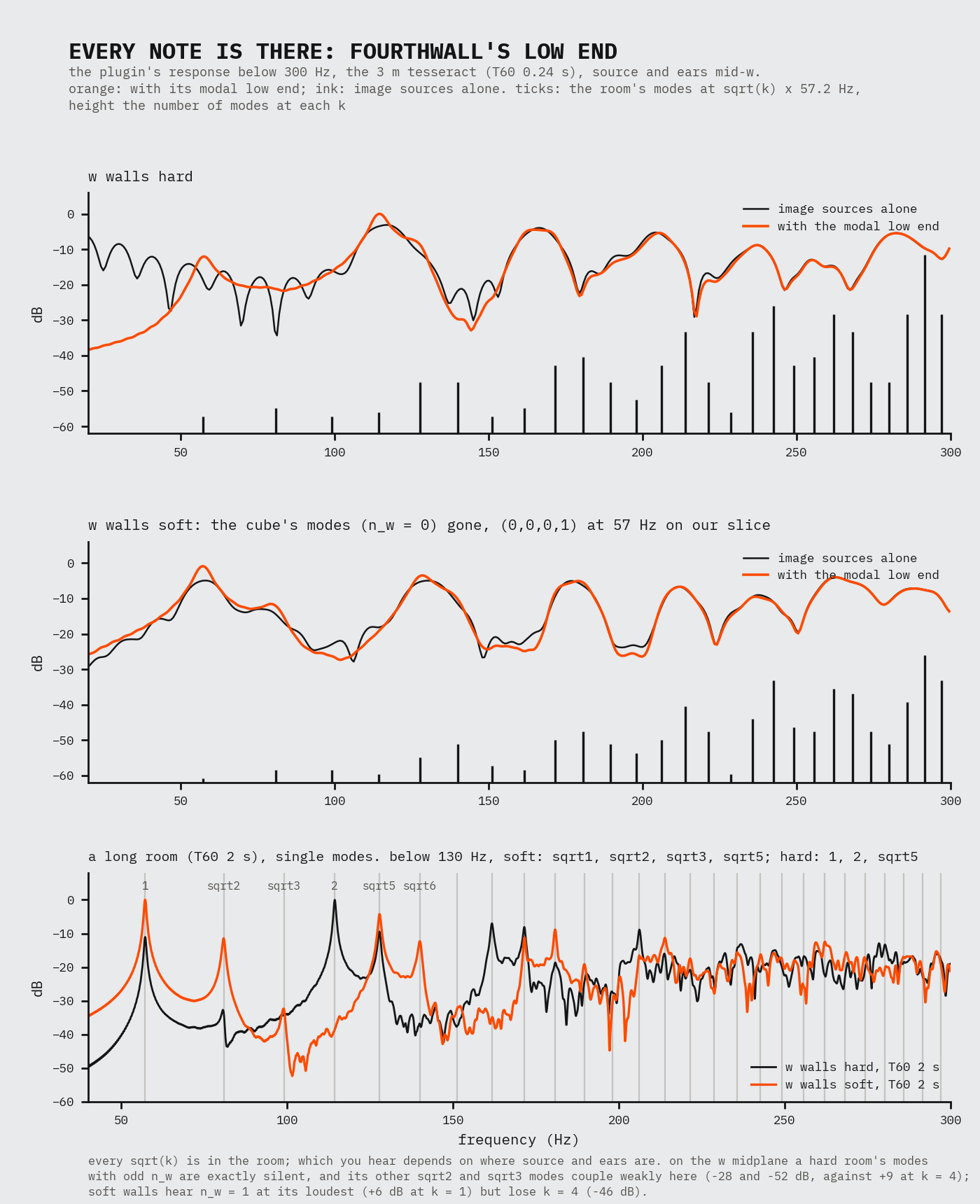
Every is in the room; which ones you hear depends on where the source and the ears are. A mode is heard in proportion to the product of its shape at the source and at the ear, so a source or an ear on a mode's node silences it. With the source and the ears on the tesseract's middle slice, as in our renders, every hard-walled mode with an odd number along the fourth axis is exactly silent there.
10Walls on the fourth axis
Make the two walls along w soft, and the room is no longer a cube's cousin.
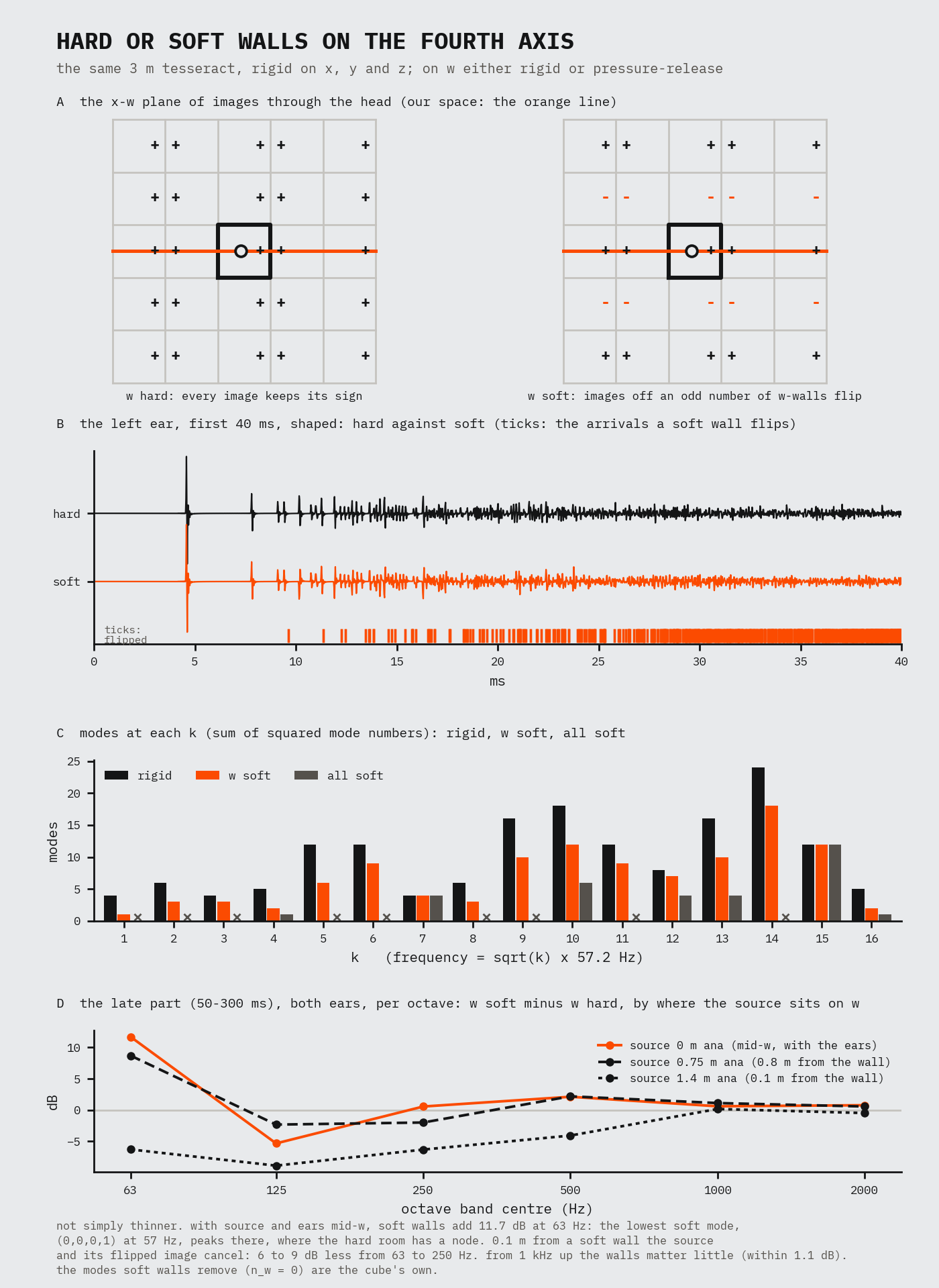
A hard wall reflects pressure as it is; a soft (pressure-release) wall reflects it inverted. Make the two walls on the fourth axis soft and keep the rest hard. Every image then carries a sign, for reflections in the w walls, and the modes along w change from cosines to sines:
No note goes missing: every still occurs. What goes is the family with , the modes that do not vary along the fourth axis, and the build checks that this family is exactly the cube's own modes, at every k below 64. So soft walls on the fourth axis make the room less like a cube, not more. Make every wall soft and notes do go missing: k = 1, 2, 3, 5, 6, 8, 9, 11, 14, 17, 24, 29, 32, 41, 56 below 64.
| k | all hard | w soft | all soft |
|---|---|---|---|
| 1 | 4 | 1 | 0 |
| 2 | 6 | 3 | 0 |
| 3 | 4 | 3 | 0 |
| 4 | 5 | 2 | 1 |
| 5 | 12 | 6 | 0 |
| 6 | 12 | 9 | 0 |
| 7 | 4 | 4 | 4 |
| 8 | 6 | 3 | 0 |
The bass depends on where the source sits along w. With the source and the ears on the middle slice, the lowest soft mode, (0,0,0,1) at 57 Hz in a 3 m room, peaks right there, where the hard room has a node: the late part gains +11.7 dB at 63 Hz. With the source 0.1 m from a soft wall it cancels against its own inverted image, and the late part loses 6.3 dB at 63 Hz and 8.9 at 125. From 1 kHz up the walls hardly matter.
11Two ears in a slice
We hear a 4D room from inside a 3D slice of it.
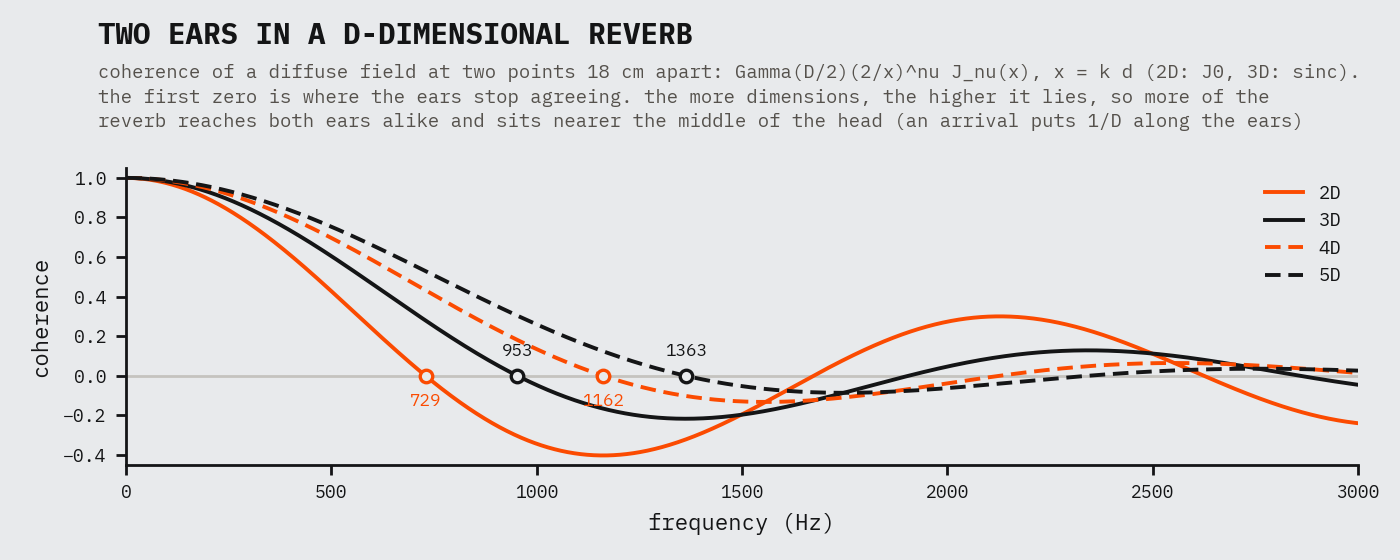
Our listener's ears lie in a 3D slice of the room. In a diffuse field, sound reaches them from every direction of the D-dimensional space, and the correlation between two points a distance apart is
which is in 3D. With ears 18 cm apart it first reaches zero at 729 Hz in 2D, 953 in 3D, 1162 in 4D and 1363 in 5D. On average the share of an arrival's direction along the line between the ears, squared, is , so the more dimensions, the more alike the two ears hear the reverb.
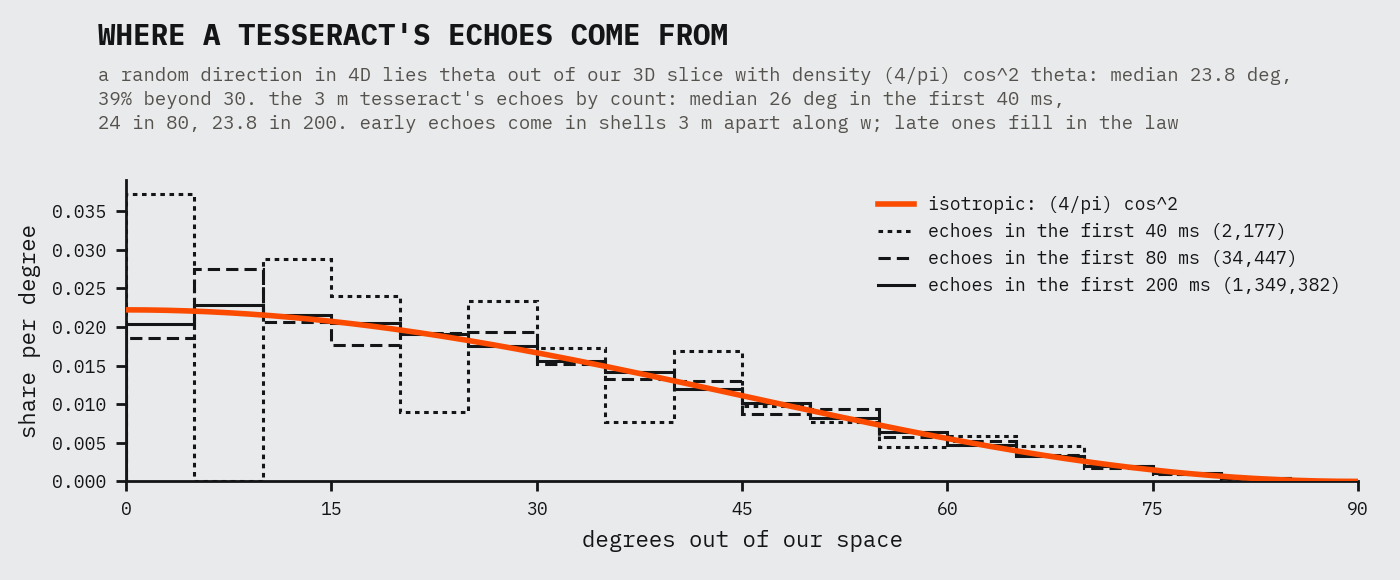
Almost every arrival in a 4D room comes from outside our slice; what matters is how far out. The angle between an arrival and the slice has density proportional to when arrivals come equally from every direction: the median is 23.8 degrees, and 39% arrive more than 30 degrees out of our space. A real tesseract's echoes only approach this law: the early ones come in shells 3 m apart along the fourth axis, and the later ones fill it in.
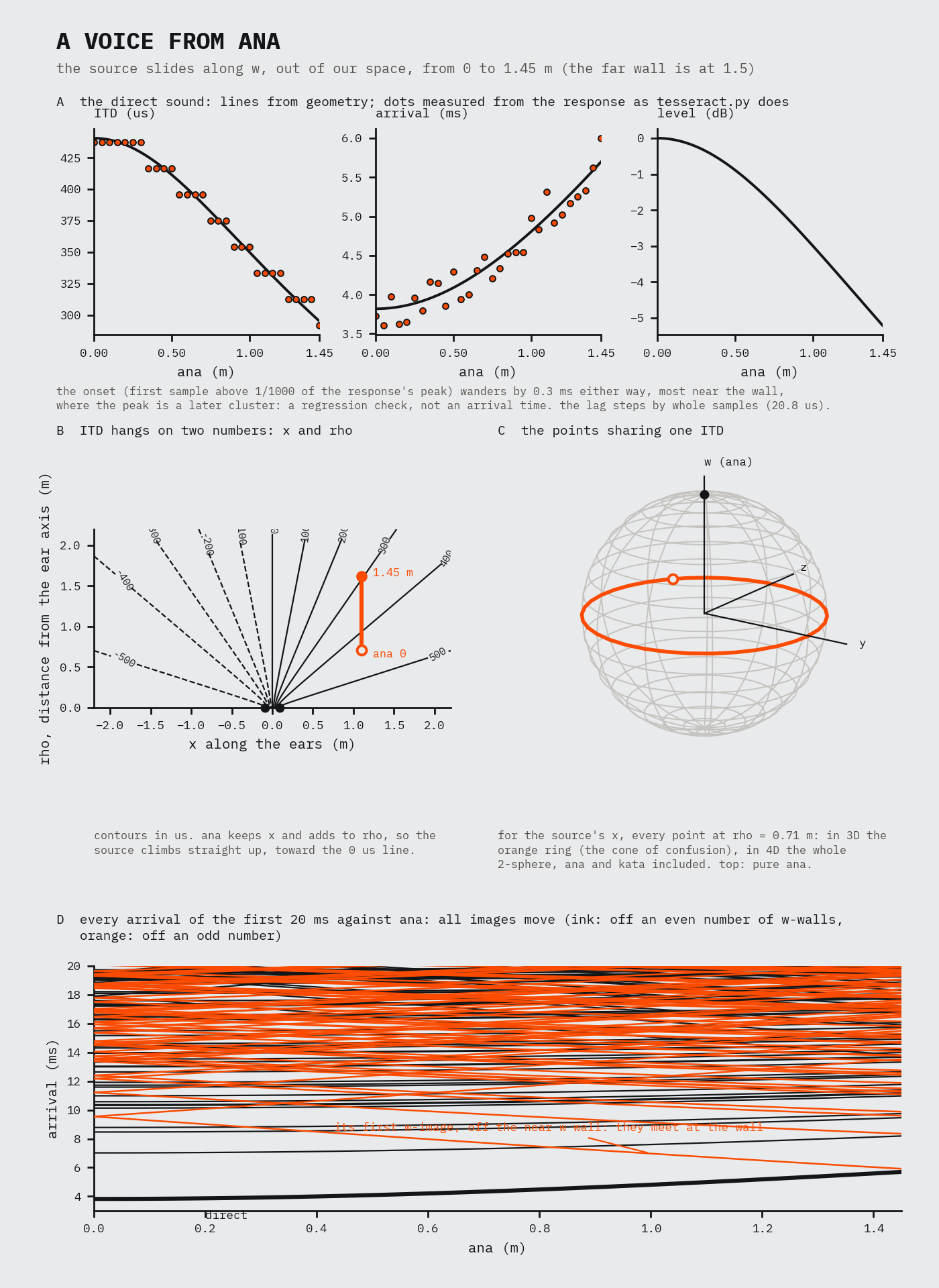
The ears lie on the x axis, so the difference between them depends on two numbers only: the source's position along x, and its distance from the ear axis, with in 4D. Every source with the same x and sounds the same to a pair of free ears, in its direct sound. In 3D that set is a ring, the cone of confusion; in 4D it is a whole 2-sphere, and the ring is its equator.
12Ana and kata
A source moved along the fourth axis loses its side.
Hinton called the two ways along the fourth axis ana and kata. Move a source a distance ana from the slice the ears are in. The path to each ear gains the same stretch along the fourth axis:
where is the distance within the slice. Ana keeps x and adds to , so the difference between the ears shrinks while the distance grows. In our render of a 3 m tesseract the source starts 1.1 m to the right: the right ear leads by 440 µs, the direct sound arrives after 3.8 ms. Moved 1.4 m ana, the lead is 301 µs and the arrival 5.6 ms. Far enough ana, any source is centred. On the sphere of confusion of section 11, pure ana is the pole. In 3D the median plane is ambiguous in a similar way (ahead, above and behind give the same difference between the ears), but there the source still has a direction in our space; here what remains is distance alone.
The source does not move alone. Every image is a copy of it, so every image moves too: those reflected an even number of times in the w walls move with the source, the odd ones the other way. The direct sound and its first image off the far w wall close in on each other and meet when the source reaches the wall.
13Between dimensions
Nothing in the formulas needs D to be whole.
, , the Hankel and Bessel functions and the powers of and above are all smooth in D. So a room of dimension 2.5 has a definite arrival shape, spreading law and echo density, and the plugin's DIMENSION knob runs continuously from 1 to 5. Treating D as a continuous number is an old trick of physics ('t Hooft and Veltman, 1972), and spaces of non-integer dimension have their own axioms (Stillinger, 1977).
The physical precedent is the fractal: a Sierpinski gasket's resonances count as a power of 1.37 (Alexander and Orbach's spectral dimension, ), so a network of ducts on that pattern would ring like a room between one and two dimensions. Some approaches to quantum gravity find the same kind of dimension running with scale: four at large distances, about two at the smallest (Ambjorn, Jurkiewicz and Loll, 2005). How many dimensions a space has can depend on the frequency you listen at.
14The tesseract in the plugin
FourthWall 0.2 has a statistical room and a tesseract.
With TESSERACT off, the late field is a train of arrivals at the rate of equation (8) for the chosen D, each with the arrival shape of that D, decaying at the DECAY time. Its simplifications: every arrival has the shape it would have at 5 m (real wakes lengthen with distance); there are no early reflections and no modes; a fractional D blends the two nearest tabulated shapes; below D = 2 the flutter of a 1D pipe is blended in by energy.
With TESSERACT on, the room is a 4-cube of side L with the listener and source of section 12, scaled to L, built from three parts.
The early part is the image sum of section 05 at each ear, signed for soft w walls, until one echo a sample or 100 ms, whichever is later. The loss per bounce comes from DECAY through the mean free path of section 07: a diffuse field reflects every , so . The images fade out over the last 20 ms (the trap of section 05) and the late part fades in, with equal power, because the two are uncorrelated.
The late part is the statistical field at D = 4, given the early part's spectrum octave by octave, not only its level: a source by a soft wall radiates less bass into the whole room, not only into its first echoes. Both parts are measured after the 4D arrival shape is applied, because much of a same-signed image train's energy is low end the shape removes.
Below a crossover (200 Hz in small rooms, lower in larger ones, fading out between about 15 and 18 m) the whole response is the room's own modes, summed exactly: the shapes of sections 09 and 10, each mode decaying as the image model says a wave in its direction must (it meets the walls of axis i times a second). The modal sum's level is not fitted: it follows from the arrival shape, which is the exact Green's function at 5 m, and the modes carry everything the shape carries, its 20 Hz high-pass and the half millisecond it starts before its front included (without those two, the modes ran up to 2 dB over the images in large rooms). In a numpy check the modal sum matches a direct image sum of the exact 4D Green's function to a few percent with hard walls and exactly with soft ones. Near a source at low frequencies the image model's far-field shape is itself wrong, since the 4D near field grows as , and there the modes are the better physics. One consequence is a longer low end: a mode nearly along one axis meets only that axis's walls, so it decays more slowly than the diffuse rate DECAY sets, and the bass rings on, as it does in real rooms with axial modes.
Every room, statistical or tesseract, any D, is scaled to the same A-weighted energy, so DIMENSION and TESSERACT change the colour of the room and not its loudness.
The plugin's tests hold all of this to numbers: the direct sound's arrival and the difference between the ears at every 5 cm of ana, to the sample; modes against images where the far field holds, in rooms from 3 to 16 m (correlation above 0.98, levels within 1 dB; a source beside a soft wall, a near-field dipole with its own inverted image, is allowed more); the bass that soft walls add or remove, against the image sum, octave by octave from 63 to 500 Hz: within 1.5 dB from 50 to 120 ms, and within 3 dB from 120 to 260 ms, where the diffuse tail and the mirror-walled image sum drift apart as section 07 says they must; and no burst at the hand-over.
15Shortcuts through the fourth dimension
A signal through the bulk can beat a signal along our slice.
If our space is a slice of a larger one and is bent within it, two points far apart along the slice can be close through the bulk. Physicists have taken this seriously: in brane-world models a signal leaving our 3D brane can travel through the extra dimension and arrive at a distant point on the brane before light travelling along it (Chung and Freese, 2000; Caldwell and Langlois, 2001; Davis, Rhodes and Vernon argue it does less than hoped). Barvinsky and Solodukhin wrote the brane's Green's function for one compact extra dimension as a sum over images: our method, applied to the universe.
For a room, take our 3D space wrapped onto a circle of radius in the x-w plane. Two points apart along our space are apart through the bulk, so the bulk path arrives first by
for points less than half the circle apart (; past that, the short way round along our space is the other way). That is 1.85 ms for points 4 m apart on a fold of radius 2 m, and 2.93 ms for 3 m on a fold of 1 m. A causal pre-echo: the sound from the next room through a dimension you cannot see, before the sound through the door. Not built yet; FOLD is its name in our plans.
16Prior art
Others got to N-dimensional rooms first.
Kelloniemi and colleagues ran a 4D digital waveguide mesh as a reverb (2007). McGovern generalised the image method to N dimensions and to fractional ones, and listened to rooms up to 12D (2011): delays in 1D, a plate in 2D, reverb with a quicker fall above 3D. NuSpace Audio's free Riviera (2017) is a plugin with rooms of any dimension, and Luo (2026) makes counting the images fast up to 12 dimensions. As far as we know, the D-dimensional arrival shape on every echo, a listener whose ears live in a 3D slice, ana and kata, soft walls on the fourth axis, and the exact modal low end with every are new here.
17The fourth direction
The idea of a fourth spatial direction has always had a following beyond mathematics.
In the 1870s the astrophysicist Johann Zollner offered seances with the medium Henry Slade as proof of a fourth spatial dimension: knots tied in sealed cords, which in four dimensions need no ends to be free. His Transcendental Physics appeared in English in 1880; one later printing on the shelves of the Library of Congress came from Harry Houdini's collection. In London, Charles Hinton built sets of coloured cubes for training a four-dimensional intuition, crediting Alicia Boole Stott, and named the directions ana and kata. In 1898 the president of the American Mathematical Society, Simon Newcomb, addressed it as the philosophy of hyper-space.
In Rochester, New York, the architect Claude Bragdon drew ornament from projections of four-dimensional figures and published A Primer of Higher Space in 1913 from his own Manas Press, which in 1920 also published his translation, with Nicholas Bessaraboff, of Ouspensky's Tertium Organum. From 1915 he staged Song and Light festivals, the first in Rochester's Highland Park, where choruses sang under his lanterns. He later drew images for the seven degrees of the diatonic scale (Godwin, 2023): one of the few places where four-dimensional geometry met music on the record.
Linda Dalrymple Henderson's history shows how much modern art took from the fourth dimension of space before relativity made time the fourth dimension. Dali hung his Christ on an unfolded tesseract in 1954 (Corpus Hypercubus). In Lovecraft's "The Dreams in the Witch House" (Weird Tales, July 1933) a student's attic room leads out of space through its angles; in "From Beyond" (written 1920) a machine lets its users perceive other planes. The house in Danielewski's House of Leaves (2000) is larger inside than out; as a room, it would return echoes later than its outside walls allow.
Music has its own higher-dimensional spaces: chords are points in orbifolds, quotients of an n-dimensional torus (Tymoczko, 2006), and just intonation lives on a lattice with one axis per prime (Tenney), so a 7-limit lattice (2, 3, 5 and 7) is a four-dimensional room of intervals, or a three-dimensional one with the octaves set aside. The universe itself has room modes: the peaks of the cosmic microwave background are the harmonics of sound in the early plasma (Hu and White, 1996). Its missing lowest modes were once read as a finite, dodecahedral universe too small to hold them (Luminet and colleagues, 2003); the Planck data have since disfavoured it.
18What is not modelled
A head or body: a 3D body in a 4D room could block sound like a paper cut-out, or be one slice of something thicker, and the two would sound different. Absorption that depends on frequency, and air absorption. Diffraction round edges. Curved 4D spaces (the 3-sphere, hyperbolic space), where sound refocuses or is lost. Each would change what is heard; none changes the arguments above.
19References
Waves, rooms and modes
- J. B. Allen and D. A. Berkley, "Image method for efficiently simulating small-room acoustics", JASA 65(4), 943-950, 1979; doi:10.1121/1.382599.
- J. Hadamard, Lectures on Cauchy's Problem in Linear Partial Differential Equations, Yale, 1923.
- R. Courant and D. Hilbert, Methods of Mathematical Physics vol. 2, 1962 (Huygens' principle).
- H. Soodak and M. S. Tiersten, "Wakes and waves in N dimensions", Am. J. Phys. 61(5), 395-401, 1993; doi:10.1119/1.17230.
- V. Balakrishnan, "Wave propagation: odd is better, but three is best", Resonance 9(6), 30-38 and 9(7), 8-17, 2004.
- H. Weyl, "Das asymptotische Verteilungsgesetz der Eigenwerte linearer partieller Differentialgleichungen", Math. Ann. 71(4), 441-479, 1912.
- M. Kac, "Can one hear the shape of a drum?", Amer. Math. Monthly 73(4, part 2), 1-23, 1966.
- J. Milnor, "Eigenvalues of the Laplace operator on certain manifolds", PNAS 51(4), 542, 1964; doi:10.1073/pnas.51.4.542.
- C. Gordon, D. L. Webb and S. Wolpert, "One cannot hear the shape of a drum", Bull. AMS 27(1), 134-138, 1992.
- H. Kuttruff, Room Acoustics, 6th ed., 2016.
- S. Alexander and R. Orbach, "Density of states on fractals: fractons", J. Physique Lett. 43, L625-L631, 1982.
- F. H. Stillinger, "Axiomatic basis for spaces with noninteger dimension", J. Math. Phys. 18(6), 1224-1234, 1977.
- G. 't Hooft and M. Veltman, "Regularization and renormalization of gauge fields", Nucl. Phys. B 44, 189-213, 1972.
- J. Ambjorn, J. Jurkiewicz and R. Loll, "The spectral dimension of the universe is scale dependent", Phys. Rev. Lett. 95, 171301, 2005.
Higher-dimensional reverbs
- A. Kelloniemi, P. Huang, V. Valimaki and L. Savioja, "Hyper-dimensional digital waveguide mesh for reverberation modeling", DAFx-07, 2007.
- S. McGovern, "The image-source reverberation model in an N-dimensional space", DAFx-11, 2011; pdf.
- NuSpace Audio, Riviera: Hyper-Room Reverb, a free plugin, 2017.
- Y. Luo, "Gauss circle lattices with geometric convolutions for synthesizing high dimensional image-source room impulse responses", DAFx26, 2026; arXiv:2606.04358.
Extra dimensions
- D. J. H. Chung and K. Freese, "Can geodesics in extra dimensions solve the cosmological horizon problem?", Phys. Rev. D 62, 063513, 2000; arXiv:hep-ph/9910235.
- R. R. Caldwell and D. Langlois, "Shortcuts in the fifth dimension", Phys. Lett. B 511, 129-135, 2001; arXiv:gr-qc/0103070.
- A.-C. Davis, C. Rhodes and I. Vernon, "Branes on the horizon", JHEP 0111:015, 2001.
- A. O. Barvinsky and S. N. Solodukhin, "Echoing the extra dimension", Nucl. Phys. B 675, 159-178, 2003; arXiv:hep-th/0307011.
- S. Deser and R. Jackiw, "Classical and quantum scattering on a cone", Commun. Math. Phys. 118, 495-509, 1988.
The fourth direction
- Edwin A. Abbott, Flatland: A Romance of Many Dimensions, 1884; Project Gutenberg #97.
- C. H. Hinton, Scientific Romances, 1884-1886 (Gutenberg #49289); A New Era of Thought, 1888; The Fourth Dimension, 1904.
- J. C. F. Zollner, Transcendental Physics, trans. C. C. Massey, London, 1880.
- S. Newcomb, "The philosophy of hyper-space", Science 7(158), 1-7, 1898.
- C. Bragdon, A Primer of Higher Space, Rochester: Manas Press, 1913; Projective Ornament, 1915.
- J. Godwin, "Claude Bragdon's images of the seven degrees of the scale", in Explorations in Music and Esotericism, Boydell and Brewer, 2023.
- P. D. Ouspensky, Tertium Organum, 1912; trans. N. Bessaraboff and C. Bragdon, Rochester: Manas Press, 1920.
- L. D. Henderson, The Fourth Dimension and Non-Euclidean Geometry in Modern Art, Princeton, 1983; revised, MIT, 2013. And "The image and imagination of the fourth dimension in twentieth-century art and culture", Configurations 17(1), 131-160, 2009.
- M. Blacklock, The Emergence of the Fourth Dimension, Oxford, 2018.
- S. Dali, Crucifixion (Corpus Hypercubus), 1954, The Metropolitan Museum of Art.
- H. P. Lovecraft, "The Dreams in the Witch House", Weird Tales, July 1933; "From Beyond", written 1920, The Fantasy Fan, June 1934.
- M. Z. Danielewski, House of Leaves, Pantheon, 2000.
- R. Rucker, The Fourth Dimension, 1984. T. Banchoff, Beyond the Third Dimension, 1990.
- D. Tymoczko, "The geometry of musical chords", Science 313, 72-74, 2006.
- J. Tenney, "On 'crystal growth' in harmonic space", Contemporary Music Review 27(1), 47-56, 2008.
- W. Hu and M. White, "Acoustic signatures in the cosmic microwave background", ApJ 471, 30-51, 1996.
- J.-P. Luminet et al., "Dodecahedral space topology as an explanation for weak wide-angle temperature correlations in the cosmic microwave background", Nature 425, 593-595, 2003; and Planck Collaboration, "Planck 2015 results. XVIII", A&A 594, A18, 2016.